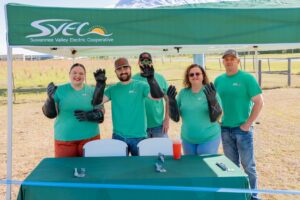

Your Voice, Your Vote
The Issues That Are Shaping Your Co-Op’s Future
Today’s electricity industry is facing challenges and changes that could impact the way SVEC brings power to our consumer-members.
While these changes affect electric systems across the country, the conversation around them often focuses on urban areas rather than rural communities. That’s why it is important for cooperatives and the people they serve to make their voices heard when it comes to important energy issues.
Here, you can find a summary of some of the biggest issues facing today’s electric cooperatives and contact information for the people who represent us in Tallahassee and Washington, D.C.
Disaster Relief Assistance
Electric cooperatives depend on Federal Emergency Management Agency reimbursements to help mitigate the cost of restoring power after natural disasters.
Co-ops believe federal processes should be streamlined to ensure timely reimbursements and reduce the interest payments on loans communities rely on while waiting for those reimbursements. Co-ops support the FEMA Loan Interest Payment Relief Act (H.R. 2672/S. 1180) that is being championed in Washington, D.C., by many of Florida’s elected representatives.
Regulations on Utility Pole Attachments
Electric cooperatives own and maintain millions of utility poles. While the primary purpose of these poles is to support the delivery of reliable electric service, co-ops can lease access to communications companies to support the deployment of broadband and other communications infrastructure.
Co-ops and communications providers regularly work together to reach mutually beneficial agreements on terms for these “pole attachment” leases, negating the need for any new onerous regulations.
Electric cooperatives believe Congress must reject any attempt to add new regulatory and compliance burdens to rules for utility pole attachments.
EPA’s Power Plant Rule
Co-ops support environmental proposals that keep our air and water clean without jeopardizing our mission of providing reliable and affordable power.
The Environmental Protection Agency has announced a final rule to require increasingly stringent carbon dioxide emissions controls at coal and new natural gas power plants unless they shut down or curtail their operations.
Electric cooperatives believe the EPA’s rule exceeds the agency’s reach by asserting vast new authority of major economic and political significance without a clear statement from Congress. Its rule also mandates inadequately demonstrated technologies and unachievable emissions limits in an unworkable timeframe.
The EPA should withdraw this rule as it will jeopardize affordable and reliable electricity by forcing the premature closure of always available power plants while also making it harder to permit, site and build critical new power plants.
Reconnecting Rural America Act
Access to broadband creates new ways to live, learn and earn in rural America. But the economics of deploying reliable, high-speed internet in rural areas is a challenge.
The U.S. Department of Agriculture has been a longtime trusted partner for rural economic development efforts, and many cooperatives are leveraging the USDA ReConnect Program to deploy broadband networks.
The recently introduced ReConnecting Rural America Act (H.R. 4227/S. 1642) would codify the USDA’s ReConnect program, taking important steps to make the program permanent and ensure that rural communities are served by broadband networks that are scalable and able to keep pace with growing consumer demands.
Let Your Voice be Heard
It’s important for every SVEC consumer-member to know about the challenges facing electric cooperatives and that we make sure our leaders hear our concerns. Here is their contact information:
U.S. Senators
U.S. Representatives
State Senators

State Representatives


Share this article