Robot Round Up
Operation Round Up Grants Are Coding Brighter Futures Through Technical Skill Mastery
Carlos Diaz is a passionate STEM instructor at Branford High School, inspiring students to explore and excel in science, technology, engineering, and mathematics. Last year, his classroom was dedicated to cybersecurity, robotics and coding. He saw the passion his students had for the subject matter and knew he needed to find a way to keep that interest going.
“When you get a bunch of kids like the ones I had last year, who were willing to put in the work and rose up to the challenges they were given, you don’t think twice when they don’t have a device they need. You just go and buy it,” he says. “That’s when SVEC’s grants come in so handy because you can start building a nice setup so those kids can continue growing their interests and developing their skills.”
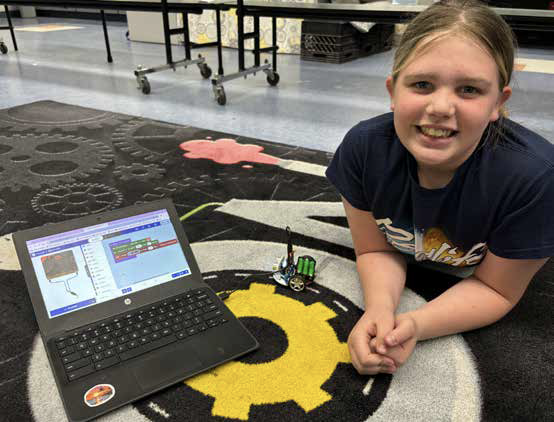
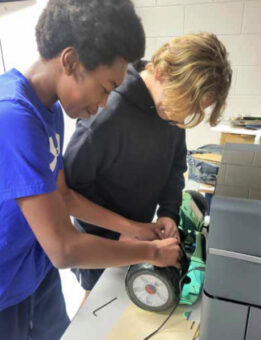
With his Operation Round Up™ grant, Diaz was able to buy a spot welder for students like Dwight to apply the skills they were learning to repair battery packs like those used in Tesla vehicles and even to make repairs to a broken two-wheeled hoverboard. He also bought a series of Micro:bit microcontrollers that allowed his fifth graders to learn how to code behaviors for their own robots.
“That was really powerful because, when you come into class, it’s boring to see somebody else code. But when you have your device in front of you, it’s yours. You can experiment and go beyond the lesson plan,” Diaz says. “These devices go a really long way. You can’t imagine how a simple grant from SVEC can benefit so many kids.”
Cutting-Edge Lessons
Lynsee Dicks, a STEAM instructor at Branford Elementary, is finding creative ways to utilize robotics in her classroom. With the help of Dash robots purchased through Operation Round Up™, she can set up activities where kids navigate robots through mazes or races depending on how well they answer questions about topics they have been learning, like petrology and the three types of rocks.
“The kids love it. They cheer each other on and help each other figure out what the answer is,” she says. “There are times that I can really integrate it into whatever we’re learning.”
Ultimately, working cutting-edge technology into as many lesson plans as possible sets students up to learn skills that will be essential in the workplace. As coding and programming become bigger parts of even more jobs, teachers like Diaz and Dicks are excited SVEC can help students start building those skills at an early stage.
“We are living in a technology-based society. So much of what we’re teaching today is going to be obsolete tomorrow,” Dicks says. “I really love it when we can get cutting-edge products that teach kids skills that they will be able to use throughout their lifetimes. I love that I can give them a little taste of that on the elementary level.”
Crossover Camp
Last year, Dicks noticed that students in her one-week lab were excited about technical subjects and the arts. But once they reached the middle and high school levels, that engagement appeared to taper off.
In an effort to maintain student interest, Dicks collaborated with Diaz on the creation of a summer robotics camp for kids in the fifth, sixth, and seventh grades. Students were provided STEM resources and instruction to build their own robotic animals. While the camp relied on a variety of funding sources, Dicks and Diaz were able to repurpose many of their classroom micro:bits controllers and programmable servo motors, originally purchased with Operation Round Up™ funds, for the camp.
“I think it’s important to keep kids interested in things like STEM, coding, and robotics so that when they transition to the middle school with a certain amount of electives to choose from, maybe some of them will choose STEM,” Dicks says. “I really love that Diaz and I get to work in tandem like that together to foster a love of coding and robotics and perhaps get more kids in the door to use these types of materials.”
Share this article