
The Cooperative Way
Money. Food. Housing. Electricity. Broadband.
Cooperatives, a locally grown business model, are steadily helping people connect with each of these basic needs. The United Nations declared 2025 the International Year of Cooperatives, and the yearlong theme — Cooperatives Build a Better World — highlights the impact co-ops have on local communities.
Co-ops are everywhere, from rural towns to big cities. Across the United States, more than 65,000 co-ops thrive. Some are owned by workers or farmers. Some, like Suwannee Valley Electric Cooperative, are owned by the people who use the services the co-ops provide. Others are owned by businesses that pool resources. And the co-op impact isn’t limited to America; 3 million co-ops support communities around the globe.
All of these co-ops share a simple mission—making life better in the communities they serve. From local credit unions fighting payday loan schemes to brand giants like Land O’Lakes helping farmers reach markets, co-ops are proof that when people work together, everyone wins.
“We’re proud of our co-op identity,” says SVEC Executive VP and CEO Michael S. McWaters. “Our members support us, and in turn, we support them with local jobs, scholarships, community grants, and economic opportunities. Co-ops connect our community, and, by working together, we’re all stronger.”
Here are three ways to strengthen your community through cooperation.
Eat Co-Op Food
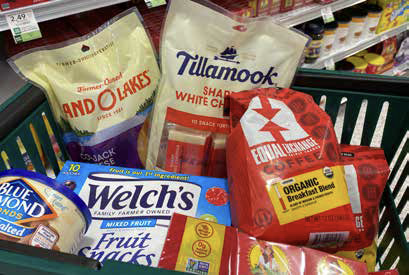
Cooperation tastes good. Farmer-owned dairy cooperatives account for 85% of the milk that flows through America, according to the U.S. Department of Agriculture. Prefer almond milk? Buy Blue Diamond, owned by almond farmers. Store shelves are packed with co-op food brands, including:
- American Crystal Sugar Co. (sugar)
- Blue Diamond (almonds, crackers, milk)
- Cabot Creamery (cheese, butter)
- Equal Exchange (chocolate, coffee, tea)
- Florida’s Natural Growers Inc. (orange juice, lemonade, grapefruit juice)
- Land O’Lakes (butter, eggs, cheese)
- Ocean Spray (cranberry juice, cranberry sauce, and fruit)
- Organic Valley (milk, cheese, butter, eggs, sour cream)
- Sunkist Growers Inc. (oranges, grapefruit, lemons, orange juice, snacks)
- SunMaid (raisins, apricots, prunes, yogurt-covered raisins, bread)
- Tillamook Creamery (cheese, ice cream, yogurt)
- Welch Foods Inc. (grape juice, spreads, snacks)
There are many regional co-op brands, too. The best way to find co-op food is at a community-owned food store.
Food co-op members have a say in what community stores stock on their shelves. There are 230 food co-ops serving communities in 39 states, and they are popular. National Co-op Grocers reports combined sales of $2.5 billion each year.
“Co-ops are essential cornerstones of their communities,” says NCG CEO C.E. Pugh. “Co-ops lead all food retailers nationwide in percentage of sales derived from local, organic, and fair-trade foods and products.”
According to NCG’s 2023 Food Impact Report, the average food co-op works with 169 local farms and producers. That’s the impact of keeping food cooperative.
Bank With Co-Ops
Does your bank have your best interest at heart? America’s Credit Union reports that credit union members are 1.4 times more likely than nonmembers to receive personalized financial counseling.
“Credit unions support and advocate for innovative programs, including pilot programs for first-time homebuyers. Credit unions are community-oriented and have an interest in any programs focused on vulnerable and underserved communities,” says Amanda Smith, America’s Credit Unions Regulatory Advocacy Senior Counsel.
Since they are not profit-driven, credit unions often offer lower loan rates and higher return rates than bank rate averages, according to Datatrac. Credit unions also pioneered payday alternative loans to help members learn to save money and avoid cycles of debt.
One of every three Americans has a credit union account. Since education and training is a shared co-op principle, many credit unions have special accounts and matching programs for children learning how to save money.
Keep money cooperative. Bank with a credit union.
Choose Co-Op Service
Sometimes you don’t have a choice about who provides services to your home. Only a few states let people pick their electricity provider, for example. But a growing number of cooperatives are offering internet access to members, competing with big providers known for tricky contracts and poor customer service.
“We’re more than a power provider,” McWaters says. “We’re your community partner, invested in the success of every member we serve.”
When you have a choice of who provides a service in your neighborhood, choose a co-op. When you do, you’re not just a customer, you’re a member-owner. You have a voice in how the co-op is run and where profits are reinvested.
Locally owned service co-ops, including SVEC, invest in the future of the areas they serve with scholarships, community grants and economic development efforts.
“Our members support us, and we support the communities where they live,” McWaters says.
Want to support your community? Join local co-ops.
Celebrate Our Co-Op Community
Why take a year to celebrate co-ops? The co-op model prioritizes people over profit and community over competition. When we work cooperatively, we invest in a better future for everyone. From your local electric utility to international fair-trade organizations, cooperatives prove that when we work together, everyone wins.
So, the next time you’re choosing where to bank, buy your groceries, or subscribe for internet access, keep it cooperative. You’re part of a global movement that’s building stronger communities and a better world, one member at a time.
Share this article